



茶室「清恵庵」
茶室「清恵庵」について
概要
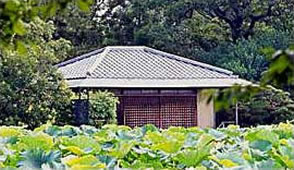 茶室「清恵庵」は佐賀県出身の実業家で、リコー三愛グループの創始者、故市村清氏(1900~1968)の御遺志により、幸恵夫人より寄贈され、1973年10月10日に、佐賀城の広い南濠に面した現在地に建てられた茶室です。
敷地面積は230平方メートル、建築面積70平方メートルで、建物は四畳半の茶室(小間)と七畳半の広間兼水屋、寄付、台所、トイレで構成されています。
設計は、日本近代の茶室建築の第一人者、堀口捨己と堀口の高弟で数寄屋建築の第一人者、早川正夫になるものです。
※堀口捨己は、日本近代の茶室建築の第一人者で、著名な研究者でもあり、国宝茶室「如庵」(犬山市 織田信長の弟、織田有楽斎が元和4年(1619年)に建築した茶室)の移築を指揮したことでも知られています。
※早川正夫は、堀口の高弟で、数寄屋建築(茶室風を取り入れた建築)の第一人者で、佐賀藩第10代藩主鍋島直正の別邸、神野御茶屋の茶室を復元した「隔林亭」(佐賀市神野公園内)の設計者でもあります。
特徴
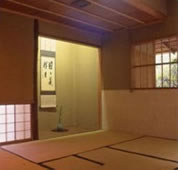 茶室建築の第一人者である堀口捨己の手による茶室で、公共の場に置かれ、誰でも中に入れるのはこの清恵庵のみであり、貴重な建築資産となっています。
設計者の一人である早川氏が「住宅建築」1975年6月号に寄稿された文章によると、清恵庵の特徴は、次のとおりです。
- 清恵庵では、建物の周囲に竹の生け垣をめぐらして内露地が構成され、特に南側は四季の移り変わりの中で様々な景観をつくりだす佐賀城の濠をそのまま「庭」の一部として見立て、水面に舟だまりをしつらえて建物が水面に映えるように造られている。
- 「庭」の中心は元から生い茂っていたムクの巨木とナンキンハゼである。
- 生け垣の外の佐賀城公園の部分を「外露地」の庭と見立てている。
- 茶室は利休好み四畳半の典型的な形を基本としている。
- 広間は、南側に濠の水面にのりだした広縁をつけて、人数が多い場合にも狭さを感じないような設計になっている。
- 茶会だけではなく、生け花や陶器鑑賞の集まりのような茶の湯に関連した広い文化芸術一般の教育に機能的に対応できるような設計になっている。
- 多目的に使用できるよう水屋が襖で隠れるようになっている。
- 手水鉢はこの場には不釣り合いな大きさだが、もと市村家所蔵の品で乃木稀典大将遺愛の品と伝えられているものを寄贈されたもので、清恵庵にゆかり深いものとして据えた。
清恵庵のご利用
- 無料で内部の見学ができます。事前の予約をお願いいたします。
- 貸出しを行っています。
- 1日の使用料は4,950円で博物館の開館時間内にご利用できます。
- 茶道具類は無料で貸出し可。持ち込みも可。
- 茶会だけでなく、研修会などにも御利用できます。和の空間を活かしたコスプレ撮影会に利用された方もいらっしゃいます。
- 火気は、茶会において茶を沸かすための使用以外は使用できません。
- 詳しくは、県立博物館総務課までお問い合わせください。
佐賀県立博物館総務課
電話番号 0952-24-3947
メールアドレス hakubi@pref.saga.lg.jp
Seikeian Teahouse(茶室 清恵庵)
The Seikeian teahouse at the Saga Prefectural Museum was designed by Horiguchi Sutemi(1895―1984),a leading figure in modern Japanese teahouse architecture,and his diciple Hayamawa Masao(1925―2013). It is one of Horiguchi's final works,and the only remaining teahouse he designed that in open to the public. The teahouse was built in 1972 and donated to the museum ny the wife of Ichimura Kiyoshi(1900―1968), the founder of electronics company Ricoh Japan. Seikeian was designed to face the southern moat of the former Saga Castle,where lotus flowers bloom in summer. Its layout allowed visitors to arrive by boat and ascend to the building via an external stairway. The stonework around the base is made of reused red stones from the castle's ramparts. The structure is larger and more versatile than a typical teahouse,consisting of a 12.5-square-meter main room and a traditional tearoom four and a half tatami mats in size. The main room's Verande overworks the moat and is intended to evoke a sense of open space even when the room is crowded. Seikeian is also much brighter than traditional teahouses,with large windows to bring in light and express connection with the building's surroundings. Its architectural feature make it suitable for a variety of uses beyond traditional tea gatherings,including ikebana flower arrangements and exhibitions of tea utensils. Inside,sliding panels are covered with locally handcrafted washi paper. The seams of the papering overlap mid-panel,producing a silhouette when lit from behind reminiscent of castle stonework. The shoji panels are designed so that, when sitting for rea,guests can see the scenery outside at eye level.
Horiguchi Sutemi(堀口捨己)
Horiguchi Sutemi(1895―1984)was an architect and historian who was instrumental in bridging traditional Japanese aesthetics and modernist design. Horigushi was born in Tokyo and studied architecture at Tokyo Imperial University. He traveled to Europe in the 1920s, where he was inspired by Wersten design concepts and modernist ideas,particularly the Dutch De Stijl art movement. Meanwhile,he also developed a keen interest in Japanese tea culture and dedicated himself to the study of tearoom architecture. His best-known works,such as the Koide House(now at the Edo-Tokyo Open Air Architectural Museum in Koganei,Tokyo),combined modern influences with the simplicity found in traditional tearooms and their sukiya architecture. His designs often make use of spatial continuity and natural light,as in the Seikeian Teahouse. Horiguchi was also a poet,translator,and essayist. His wrirings on Japanese gardens,teahouse design,and the meaning of space are considered essential reading in Japanese architectural theory. He also wrote about Western architects and helped found Japan's first modern architectural movement in the 1920's. The movement promoted individual artistic expression and encouraged breaking away from historical styles.
(この英語解説文は観光庁の令和7年度地域観光資源の多言語解説整備支援事業で英語ネイティブの取材に基づき作成しました。)
